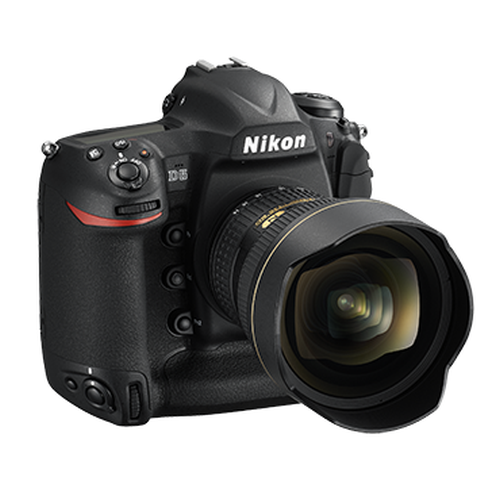
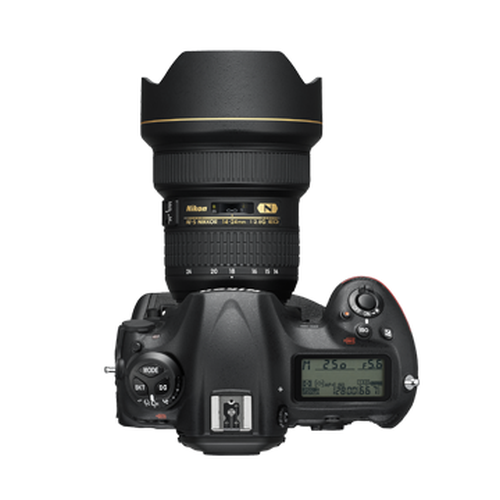
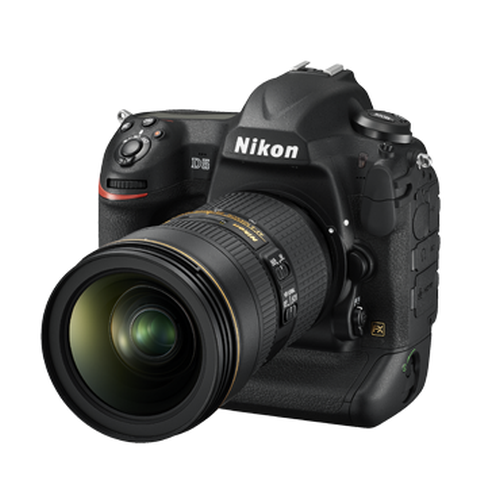
ACQUIRE AND HOLD SUBJECTS TIGHT: THE HEART OF THE NEW-GENERATION AF SYSTEM — 153 AF POINTS WITH 99 CROSS-TYPE SENSORS × DEDICATED AF ENGINE —
The D5 features an AF system with 153 densely packed focus points (55 selectable points)*, that are compatible with all AF NIKKOR lenses and provide over 130% coverage compared to the D4S. Ninety-nine of them feature cross sensors, with superior subject-detection performance, that are distributed efficiently in central and peripheral areas, delivering more compositional freedom. With higher accuracy for overall subject detection, including small subjects as well as those with low overall contrast, sharp focus is now ensured. * Number of focus points that function as cross sensors may vary depending on lens and maximum aperture.
Newly developed to keep noise to an absolute minimum, the D5’s Multi-CAM 20K autofocus sensor module achieves focus at -3 EV* with all AF points, and at -4 EV* with the central focus point. This makes autofocus possible even when your subject is in a low-light or low-contrast situation. By combining superb image quality, provided up to the highest standard ISO sensitivity setting of 102400, and metering with extended low-light performance, the D5 significantly broadens the scope of your shooting opportunities. * At ISO 100 and 20°C/68°F.
The D5 is newly equipped with a dedicated AF engine chip, capable of rapid calculations. Between this engine and the sequence control microcomputer, several tasks are handled in parallel, resulting in overall shorter processing time for autofocus calculations and control. In addition, a newly developed AF algorithm efficiently coordinates a range of operations — including advanced subject detection and detailed scene analysis — based on rapid calculation by the AF engine, realizing more reliable acquisition and tenacious tracking of moving subjects. Precise AF tracking is possible even when capturing fast-moving subjects at approx. 12-fps continuous shooting speeds. This superior AF performance during high-speed continuous shooting results in a camera system of unprecedented power — power which is compounded even further when used with the latest NIKKOR super-telephoto lenses.
When using a teleconverter, all 153 focus points are compatible with effective apertures of f/5.6 or faster*. Even when apertures are slower than f/5.6, autofocusing is possible in many scenes. Fifteen focus points with nine selectable points are compatible with an effective aperture of f/8. * Number of effective cross sensors varies with certain lens combinations.
INCREASED, CLOSER-KNIT FOCUS POINTS ENHANCE ALL SEVEN AF-AREA MODES — 7 AF-AREA MODES × QUICK MODE SWITCHING FUNCTION —
The new AF system enhances all seven AF-area modes. Taking advantage of the new, smaller focus points, single-point AF achieves pinpoint focus more accurately. In dynamic-area AF (25, 72 and 153 points), group-area AF, 3D-tracking and auto-area AF, the increased number of focus points densely covers each AF area, enhancing subject acquisition. Auto-area AF is particularly effective when shooting subjects that move around freely, such as figure skaters or ice dancers. As the camera automatically detects subjects and focuses in this mode, you can concentrate more on composition and selecting moments to capture. Even during high-speed shooting, the camera demonstrates accurate focusing. Single-point AF: The camera achieves focus with a selected point. Dynamic-area AF (25, 72 and 153 points): The camera acquires the subject with one selected primary focus point. If the subject leaves this selected point during tracking, the camera continues to focus, based on the information from surrounding points (areas covered by 25, 72 or 153 points*). This is effective for erratic movement that is hard to follow with one focus point. * In dynamic-area AF with 25 or 72 points, the number of focus points actually used may be less than 25 or 72, depending on the selected primary focus point. Group-area AF: The camera recognizes the subject as an area, using the selected point and surrounding points as a group. This is highly effective for erratic movement that is difficult to capture with one point. If faces are detected in AF-S lens servo mode, the camera prioritizes them as portrait subjects. 3D-tracking: The camera uses color information of the subject that is initially focused by your selected point. It maintains focusing by automatically changing the focus point within all 153 points, following the subject’s movement, as long as the shutter-release button is pressed halfway. This is an advantage when shooting moving subjects in a creative composition. Auto-area AF: The camera identifies the major subject automatically using all 153 points and achieves focus. When faces are detected, it prioritizes them as portrait subjects in any lens servo mode.
Switching between AF-area modes is faster as you can assign different modes to custom buttons (Pv, Fn1, Fn2 or lens focus function and other buttons). When the button is pressed, the camera switches to the pre-assigned AF-area mode (not including 3D-tracking). Release the button and the D5 reverts to the original AF-area mode. This lets you change AF-area modes quickly and flexibly according to the subject matter and purpose.
FLEXIBLE AF CUSTOMIZING OPTIONS FOR POWERFUL SUBJECT ACQUISITION — ADJUSTABLE AF LOCK-ON × AUTO SETTING FOR AF FINE-TUNE —
The performance of AF lock-on, or “Focus tracking with lock-on*,” can be adjusted by two parameters: “Blocked shot AF response” and “Subject motion.” The former option adjusts AF response when an object passes between the subject and camera on a scale from “Quick (quicker response and easier to shift focus to the intervening object and then return it to the original subject)” to “Delayed (less likely to lose focus from the original subject).” The latter option can be toggled according to the subject’s movement characteristics towards the camera, from “Erratic (movement prone to sudden starts and stops)” to “Steady (movement at a constant speed).” * Available in AF-C lens servo mode.
Type
Single-lens reflex digital camera
Lens mount
Nikon F mount, (with AF coupling and AF contacts)
Image sensor format
FX
Image sensor type
CMOS
Sensor size
35.9mm, x23.9mm
Total pixels
21.33million
Dust-reduction system
Image sensor cleaning, Image Dust Off reference data (Capture NX-D software required)
Effective pixels
20.8million
Image size (pixels)
FX (36x24) image area, (L)5568, x3712, (M)4176, x2784, (S)2784, x1856, 1.2x (30x20) image area, (L)4640, x3088, (M)3472, x2312, (S)2320, x1544, DX (24x16) image area, (L)3648, x2432, (M)2736, x1824, (S)1824, x1216, 5 : 4 (30x24) image area, (L)4640, x3712, (M)3472, x2784, (S)2320, x1856, FX-format photographs taken during movie recording at a frame size of 1920 x 1080 or 1280 x 720, (L)5568, x3128, (M)4176, x2344, (S)2784, x1560, DX-format photographs taken during movie recording at a frame size of 1920 x 1080 or 1280 x 720, (L)3648, x2048, (M)2736, x1536, (S)1824, x1024, Photographs taken during movie recording at a frame size of 3840 x 2160: 3840 x 2160 Photographs taken during movie recording at a frame size of 1920 x 1080 crop: 1920 x 1080
File format
NEF (RAW): 12 or 14 bit (lossless compressed, compressed, or uncompressed); large, medium, and small available (medium and small images are recorded at a bit depth of 12 bits using lossless compression), TIFF (RGB), JPEG: JPEG-Baseline compliant with fine (approx. 1 : 4), normal (approx. 1 : 8), or basic (approx. 1 : 16) compression; optimal quality compression available, NEF (RAW)+JPEG: Single photograph recorded in both NEF (RAW) and JPEG formats
Picture Control system
Standard, Neutral, Vivid, Monochrome, Portrait, Landscape, Flat, selected Picture Control can be modified; storage for custom Picture Controls
Media
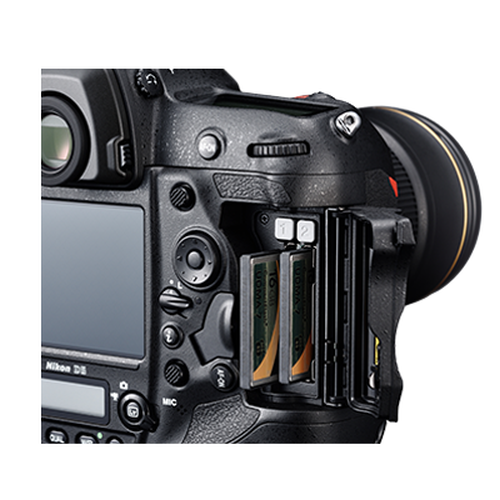
XQD, CompactFlash (CF) (Type I, UDMA compliant)
Card slot
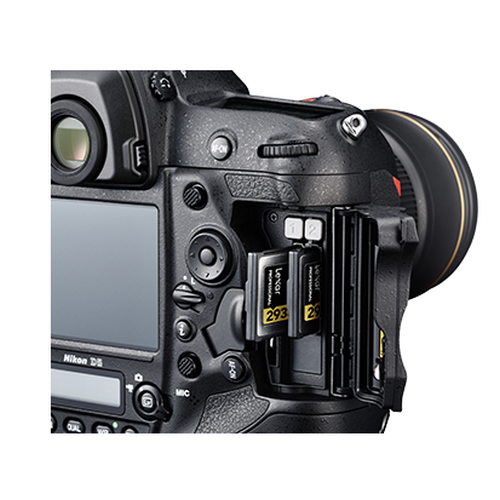
2 XQD cards or 2 CompactFlash (CF) cards, Slot 2 can be used for overflow or backup storage or for separate storage of copies created using NEF+JPEG; pictures can be copied between cards.
File system
DCF 2.0, Exif 2.3, PictBridge
Viewfinder
Eye-level pentaprism single-lens reflex viewfinder
Frame coverage
FX (36x24): Approx. 100% horizontal and 100% vertical, 1.2x (30x20): Approx. 97% horizontal and 97% vertical, DX (24x16): Approx. 97% horizontal and 97% vertical, 5:4 (30x24): Approx. 97% horizontal and 100% vertical
Magnification
Approx. 0.72 x (50 mm f/1.4 lens at infinity, –1.0 m{sup(-1)})
Eyepoint
17 mm (–1.0 m{sup(-1)}; from center surface of viewfinder eyepiece lens)
Diopter adjustment
-3 to +1 m{sup(-1)}
Focusing screen
Type B BriteView Clear Matte Mark IX screen with AF area brackets (framing grid can be displayed)
Reflex mirror
Quick-return type
Depth-of-field preview
Yes, Pressing Pv button stops lens aperture down to value selected by user (A and M modes) or by camera (P and S modes)
Lens aperture
Instant return, electronically controlled
Compatible lenses
Compatible with AF NIKKOR lenses, including type G, E, and D lenses (some restrictions apply to PC lenses) and DX lenses (using DX 24 x 16 1.5x image area), AI-P NIKKOR lenses, and non-CPU AI lenses (exposure modes A and M only). IX NIKKOR lenses, lenses for the F3AF, and non-AI lenses can not be used. The electronic rangefinder can be used with lenses that have a maximum aperture of f/5.6 or faster (the electronic rangefinder supports 15 focus points with lenses that have a maximum aperture of f/8 or faster, of which 9 points are available for selection).
Type
Electronically-controlled vertical-travel focal-plane mechanical shutter; electronic front-curtain shutter available in mirror up release mode
Speed
1/8000to, 30s, in steps of 1/3, 1/2, or 1 EV, bulb, time, X250
Flash sync speed
X=, 1/250s;, synchronizes with shutter at 1/250 s or slower
Modes
S (single frame), CL (continuous low speed), CH (continuous high speed), Q (quiet shutter-release), Self-timer, MUP (mirror up)
Approximate frame advance rate
12fps, Up to 10 fps (CL); 10–12 fps, or 14 fps with mirror up (CH); or 3 fps (quiet continuous mode)
Self-timer
2 s, 5 s, 10 s, 20 s; 1 to 9 exposures at intervals of 0.5, 1, 2, or 3 s
Metering system
TTL exposure metering using RGB sensor with approximately 180K (180,000) pixels
Metering method
Matrix: 3D color matrix metering III (type G, E, and D lenses); color matrix metering III (other CPU lenses); color matrix metering available with non-CPU lenses if user provides lens data Center-weighted: Weight of 75% given to 12 mm circle in center of frame. Diameter of circle can be changed to 8, 15, or 20 mm, or weighting can be based on average of entire frame (non-CPU lenses use 12-mm circle) Spot: Meters 4 mm circle (about 1.5% of frame) centered on selected focus point (on center focus point when non-CPU lens is used) Highlight-weighted: Available with type G, E, and D lenses
Range
(ISO 100, f/1.4 lens, 20 °C/68 °F) Matrix or center-weighted metering: –3 to +20 EV Spot metering: 2 to 20 EV Highlight-weighted metering: 0 to 20 EV
Exposure meter coupling
CPU, AI
Mode
Programmed auto with flexible program (P); shutter-priority auto (S); aperture-priority auto (A); manual (M)
Exposure compensation
–5 to +5EV, in steps of1/3, 1/2, or 1EV
Exposure lock
Luminosity locked at detected value
ISO sensitivity (Recommended Exposure Index)
ISO100to, 102400, in steps of1/3, 1/2, or 1EV, Can also be set to approx. 0.3, 0.5, 0.7, or 1 EV (ISO 50 equivalent) below ISO 100 or to approx. 0.3, 0.5, 0.7, 1, 2, 3, 4, or 5 EV (ISO 3280000 equivalent) above ISO 102400; auto ISO sensitivity control available
Active D-Lighting
Can be selected from Auto, Extra high +2/+1, High, Normal, Low, or Off
Autofocus system
Multi-CAM 20K autofocus sensor module with TTL phase detection, fine-tuning, and 153 focus points (including 99 cross-type sensors and 15 sensors that support f/8), of which 55 (35 cross-type sensors and 9 f/8 sensors) are available for selection
Detection range
–4 to +20 EV (ISO 100, 20 °C/68 °F)
Lens servo
Single-servo AF (AF-S), Continuous-servo AF (AF-C), predictive focus tracking automatically activated according to subject status, Manual focus (M):, Electronic rangefinder can be used
Focus point
153, 153 focus points, of which 55 or 15 are available for selection
AF-area mode
Single-point AF, 25-, 72-, or 153- point dynamic-area AF, 3D-tracking, group-area AF, auto-area AF
Focus lock
Focus can be locked by pressing shutter-release button halfway (single-servo AF) or by pressing the center of the sub-selector
Control
TTL: i-TTL flash control using RGB sensor with approximately 180K (180,000) pixels; i-TTL balanced fill-flash for digital SLR is used with matrix, center-weighted, and highlight-weighted metering, standard i-TTL fill-flash for digital SLR with spot metering
Mode
Front-curtain sync, slow sync, rear-curtain sync, red-eye reduction, red-eye reduction with slow sync, slow rear-curtain sync, off, Auto FP High-Speed Sync supported
Flash compensation
-3 to +1 EV in steps of 1/3, 1/2 or 1 EV
Flash-ready indicator
Lights when optional flash unit is fully charged; flashes after flash is fired at full output
Accessory shoe
ISO 518 hot-shoe with sync and data contacts and safety lock
Nikon Creative Lighting System (CLS)
Supported
Radio-controlled Advanced Wireless Lighting
Supported
Unified flash control
Supported
Sync terminal
ISO 519 sync terminal with locking thread
White balance
Auto (3 types), incandescent, fluorescent (7 types), direct sunlight, flash, cloudy, shade, preset manual (up to 6 values can be stored, spot white balance measurement available during live view), choose color temperature (2500 K to 10,000 K), all with fine-tuning.
Bracketing types
Exposure, Flash, White balance, ADL
Modes
Movie live view, Photo live view with available silent mode
Lens servo
Autofocus (AF): Single-servo AF (AF-S); full-time-servo AF (AF-F) Manual focus (M)
AF-area mode
Face-priority AF, Wide-area AF, Normal-area AF, Subject-tracking AF
Autofocus
Contrast-detect AF anywhere in frame (camera selects focus point automatically when face-priority AF or subject-tracking AF is selected)
Metering
TTL exposure metering using main image sensor
Metering method
Matrix, center-weighted, or highlight-weighted
Frame size (pixels) and frame rate
3840 x 2160 (4K UHD); 30p (progressive), 25p, 24p 1920 x 1080; 60p, 50p, 30p, 25p, 24p 1920 x 1080 crop; 60p, 50p, 30p, 25p, 24p 1280 x 720; 60p, 50p Actual frame rates for 60p, 50p, 30p, 25p, and 24p are 59.94, 50, 29.97, 25, and 23.976 fps respectively; high quality available at all frame sizes, normal quality available at all sizes except 3840 x 2160
File format
MOV
Video compression
H.264/MPEG-4 Advanced Video Coding
Audio recording format
Linear PCM
Audio recording device
Built-in stereo or external microphone; sensitivity adjustable
ISO sensitivity
Exposure modes P, S, and A: Auto ISO sensitivity control (ISO 100 to Hi 5) with selectable upper limit Exposure mode M: Auto ISO sensitivity control (ISO 100 to Hi 5) available with selectable upper limit; manual selection (ISO 100 to 102400 in steps of 1/3, 1/2, or 1 EV) with additional options available equivalent to approximately 0.3, 0.5, 0.7, 1, 2, 3, 4, or 5 EV (ISO 3280000 equivalent) above ISO 102400
Other options
Index marking, time-lapse movies
Monitor size
8cm (3.2–in.) diagonal
Monitor type
TFT touch-sensitive LCD with 170 ° viewing angle, approximately 100% frame coverage, and manual monitor brightness control
Monitor resolution
Approx.2359k-dot, (XGA)
Playback
Full-frame and thumbnail (4, 9, or 72 images) playback with playback zoom, movie playback, photo and/or movie slide shows, histogram display, highlights, photo information, location data display, auto image rotation, picture rating, voice memo input and playback, and IPTC information embedding and display
USB connector
SuperSpeed USB (USB 3.0 Micro-B connector), connection to built-in USB port is recommended
HDMI output connector
Type C HDMI connector
Audio input
Stereo mini-pin jack (3.5mm diameter; plug-in power supported)
Audio output
Stereo mini-pin jack (3.5mm diameter)
Ten-pin remote terminal
Can be used to connect optional remote control, WR-R10 (requires WR-A10 adapter) or WR-1 wireless remote controller, GP-1/GP-1A GPS unit, or GPS device compliant with NMEA0183 version 2.01 or 3.01 (requires optional MC-35 GPS adapter cord and cable with D-sub 9-pin connector)
Ethernet connector
RJ-45 connector Standards: IEEE 802.3ab (1000BASE-T)/IEEE 802.3u (100BASE-TX)/IEEE 802.3 (10BASE-T) Data rates: 10/100/1000 Mbps with auto detect (maximum logical data rates according to IEEE standard; actual rates may differ) Port: 1000BASE-T/100BASE-TX/10BASE-T (AUTO-MDIX)
Peripheral connector
For WT-6, WT-5
Supported languages
Arabic, Bengali, Bulgarian, Chinese (Simplified and Traditional), Czech, Danish, Dutch, English, Finnish, French, German, Greek, Hindi, Hungarian, Indonesian, Italian, Japanese, Korean, Marathi, Norwegian, Persian, Polish, Portuguese (Portugal and Brazil), Romanian, Russian, Serbian, Spanish, Swedish, Tamil, Telugu, Thai, Turkish, Ukrainian, Vietnamese
Battery
One rechargeable Li-ion EN-EL18a battery
AC adapter
EH-6b AC adapter; requires EP-6 power connector (available separately)
Tripod socket
1/4–in. (ISO 1222)
Dimensions (W x H x D)
Approx.160, x158.5, x92mm (6.3, x6.3, x3.7in.)
Weight
Approx.1405g (3 lb. 1.6 oz.), with battery and two XQD memory cards but without body cap and accessory shoe cover; approx. 1235 g/2 lb. 11.6 oz. (camera body only)
Weight 2
Approx.1415g (3 lb. 1.9 oz.), with battery and two CompactFlash memory cards but without body cap and accessory shoe cover; approx. 1240 g/2 lb. 11.8 oz. (camera body only)
Operating environment
0 °C to 40 °C (+32 °F to 104 °F)
Supplied accessories
Body Cap BF-1B, Accessory Shoe Cover BS-3, Rechargeable Li-ion Battery EN-EL18a with terminal cover, Battery Charger MH-26a with power cable and two contact protectors (shape of power cable depends on country of sale), USB Cable Clip, HDMI Cable Clip, USB Cable UC-E22, Strap AN-DC15
1. Unless otherwise stated, all measurements are performed in conformity with Camera and Imaging Products Association (CIPA) standards or guidelines. All figures are for a camera with a fully-charged battery. Nikon reserves the right to change the appearance and specifications of the hardware and software described in these specifications at any time and without prior notice. Nikon will not be held liable for damages that may result from any mistakes that these specifications may contain.